
Why Most Appraisals Come in at the Contract Price (And Why That's Not a Coincidence)
I recently negotiated an offer that was $30,000 below the asking price for a buyer, and the seller accepted it. My buyer was thrilled— we felt like we'd negotiated a great deal.
Then the appraisal came back... at our contract price.
My buyer was disappointed. He thought, "Wait a minute. If we got the house for $30,000 less, shouldn't the appraisal show it's worth $30,000 more?"
It's a common misunderstanding, and one I often find myself educating both buyers and sellers on.
Is There A Link Between Appraisals and Contract Price?
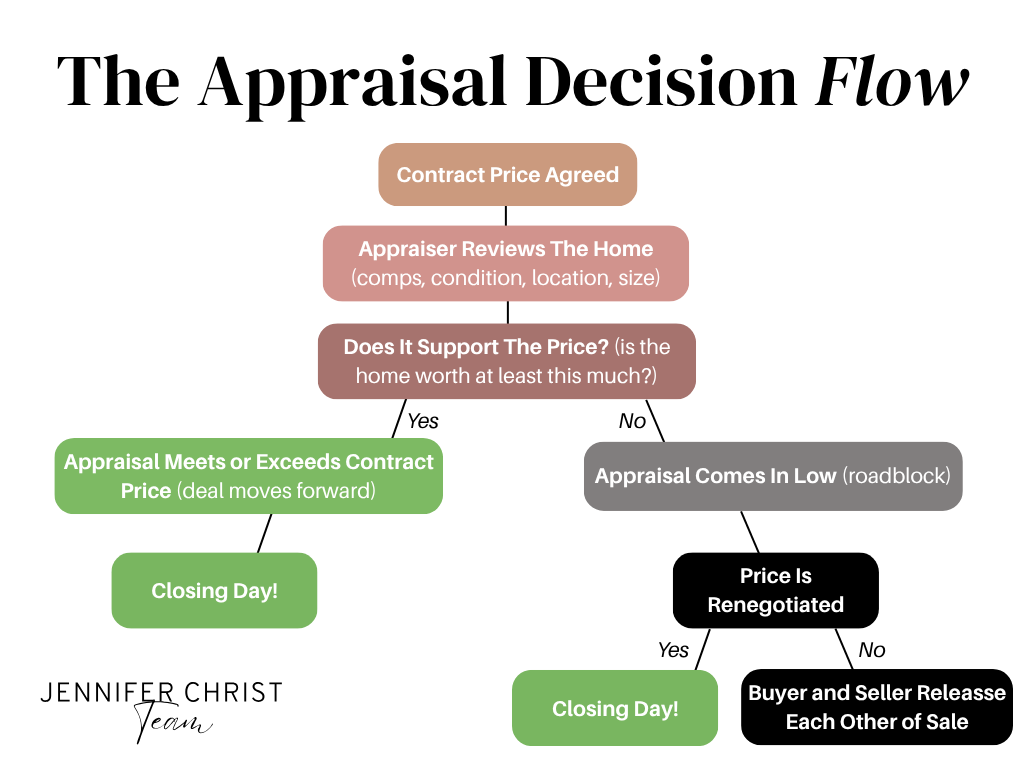
An appraiser's job isn't to determine the highest possible value of the home. Their job is to determine whether the agreed-upon purchase price is supported by the market. They review recent comparable sales, the home's condition, location, size, and other factors to answer one question: Is this home worth at least what the buyer has agreed to pay?
If the answer is yes, the appraiser has done their job.
In the likely scenario that an appraisal comes back identical to the contract price, as in my buyer's case, the appraiser isn't saying the home couldn't possibly be worth more. But once they determine that the agreed-upon purchase price is fully supported by the market, they have accomplished the purpose of the appraisal. Their assignment wasn't to find the highest value the home might justify, it was to determine whether the lender was making a sound loan based on the agreed-upon purchase price.
Here is something else buyers often overlook: once their sale closes, the price they pay becomes the strongest and most recent evidence of that home's value. Said another way, when the property successfully sells on that beautiful and exciting closing day, that home becomes a comparable that appraisers and real estate professionals may use when evaluating future properties, thus setting the new value in that market.
But what about appraisals that come in under the contract price? It does happen, typically if a home is priced well above recent comparable sales or if there simply aren't enough similar homes to support the value. But when a home is priced based on solid market data, low appraisals are far less common than many people think.
The takeaway? A successful appraisal isn't about getting the highest number possible; it's about confirming that the agreed-upon price is supported by the market.
Whether you are looking to buy or sell, make sure you hire an active agent who understands current value and trends. Otherwise, you may find yourself three weeks into a transaction, only to face an upside-down appraisal that becomes a roadblock to what should have been an otherwise very happy closing day.
Are Zillow Zestimates Accurate?
Since we are talking about home value today, I thought it would be a good time to revisit the popular topic of Zestimates. Every time I'm on a listing interview, I am reminded of just how heavily homeowners rely on Zillow's Zestimate as the golden rule when it comes to home value.
While Zillow's Zestimate can be a great indicator of general value, their algorithm is simply that: an algorithm. It can't possibly compute the specifics of your exact home and the specific buyer trends in your micro market.
Remember that time I got my seller $98,000 over the Zillow estimate? Read more here.
I'm about to close on a property $143,000 over the Zestimate, making for some very happy sellers. And the home appraised, and I knew it would, because I was basing my analysis on that micro market.
I'll share more once it's closed. But for now, check out a couple of my Q1 and Q2 listings where I put more money in my sellers' pockets than the Zestimate dictated. And if you're thinking of selling, allow me the opportunity to try and do the same for you.
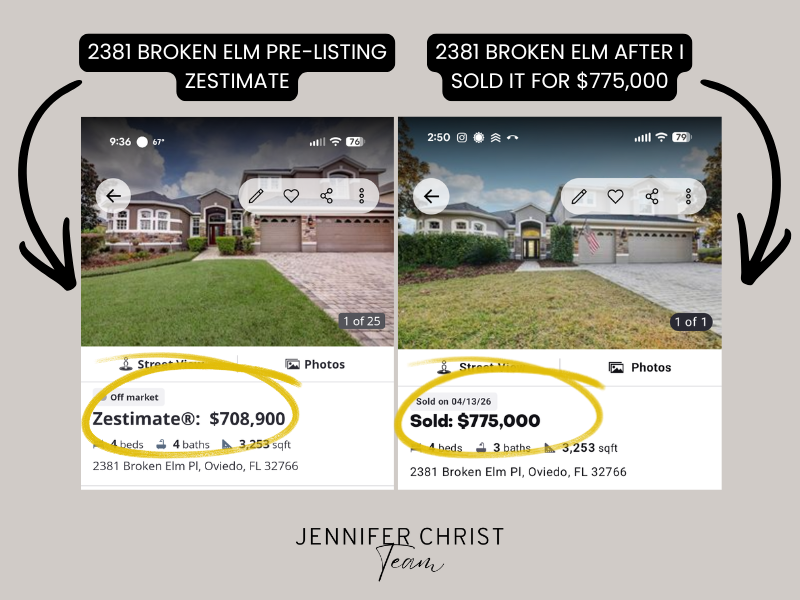
See screenshots of Oviedo’s 2381 Broken Elm’s pre-listing Zestimate, and what I sold it for, which was $66,100 higher!
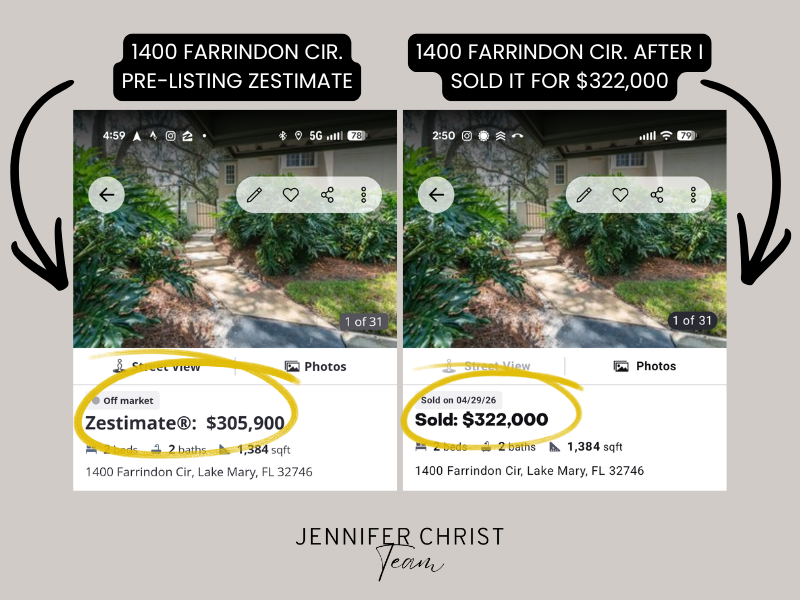
And check out my recent SOLD listing in Lake Mary, 1400 Farrindon. The pre-listing Zestimate and what I sold it for, which was $16,100 higher!
Questions about appraisals, Zestimates, or the Central Florida real estate market? Send me a message, I’m always happy to help!
